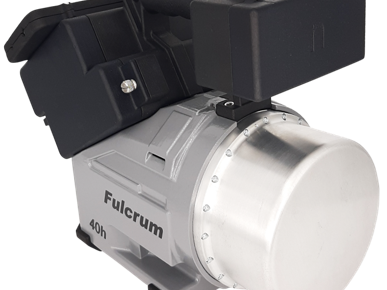
Fulcrum-40h response to the 2022 and 2026 Sandia evaluations against NEST HPGe requirements
Abstract
This note addresses findings from the 2022 and 2026 Sandia reports. New Fulcrum-40h firmware improves energy resolution at higher count rates and matches the Detective-X pile-up correction to 30 kcps.
Contents
1Summary
Sandia National Laboratories evaluated the Fulcrum-40h in a head-to-head comparison with the ORTEC Detective-X in 2022 [1]. In 2026, they reassessed the Fulcrum-40h against current NNSA NEST HPGe Detector System Requirements [3, 2].
The reassessment used the same unit from the 2022 testing, which ran legacy signal processing firmware, and was stored unpowered for an extended period of time. PHDS was not consulted before the reassessment testing.
Nevertheless, the reassessment demonstrated the Fulcrum-40h unit meeting most NEST requirements. Open items were energy resolution at 122 and 1332.5 keV, pulse pile-up correction at high count rate, and three software requirements within the user interface. All of these open items have been addressed with software and firmware updates since the 2022 testing, and internal PHDS testing with an updated Fulcrum system meets or matches the best available alternative on every NEST requirement.
This note addresses each finding from the 2026 study with measured data. The largest change is in high-rate signal processing: the current firmware makes energy resolution independent of count rate and matches the Detective-X pile-up correction to 30 kcps.
4.7 lb lighter
Than the Detective-X, with batteries installed
12.1 lb vs 16.8 lb (ORTEC)
14% better resolution at high count rates
Expected Fulcrum-40h peak width at 30 kcps, current firmware
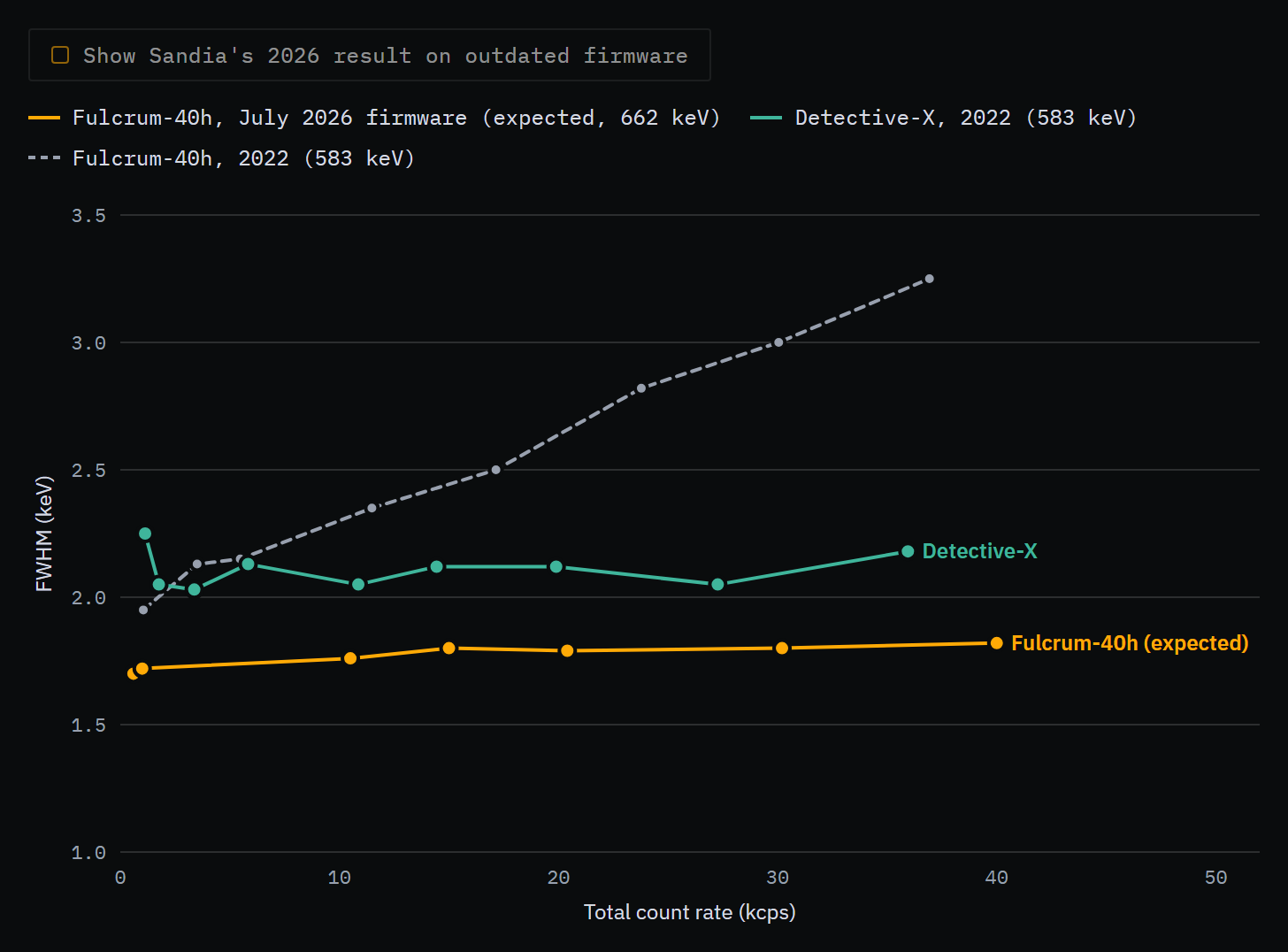
About 1.8 keV vs about 2.1 keV (Detective-X, 2022)
Up to 91% more efficient at low energies
At least 23% more efficient from 60 to 300 keV
Sandia 2022, six-unit averages
Pile-up gap closed to 1 point
At 30 kcps, down from 10 points in 2022
90% vs 91% of expected peak counts
2Overview of changes since 2022 testing
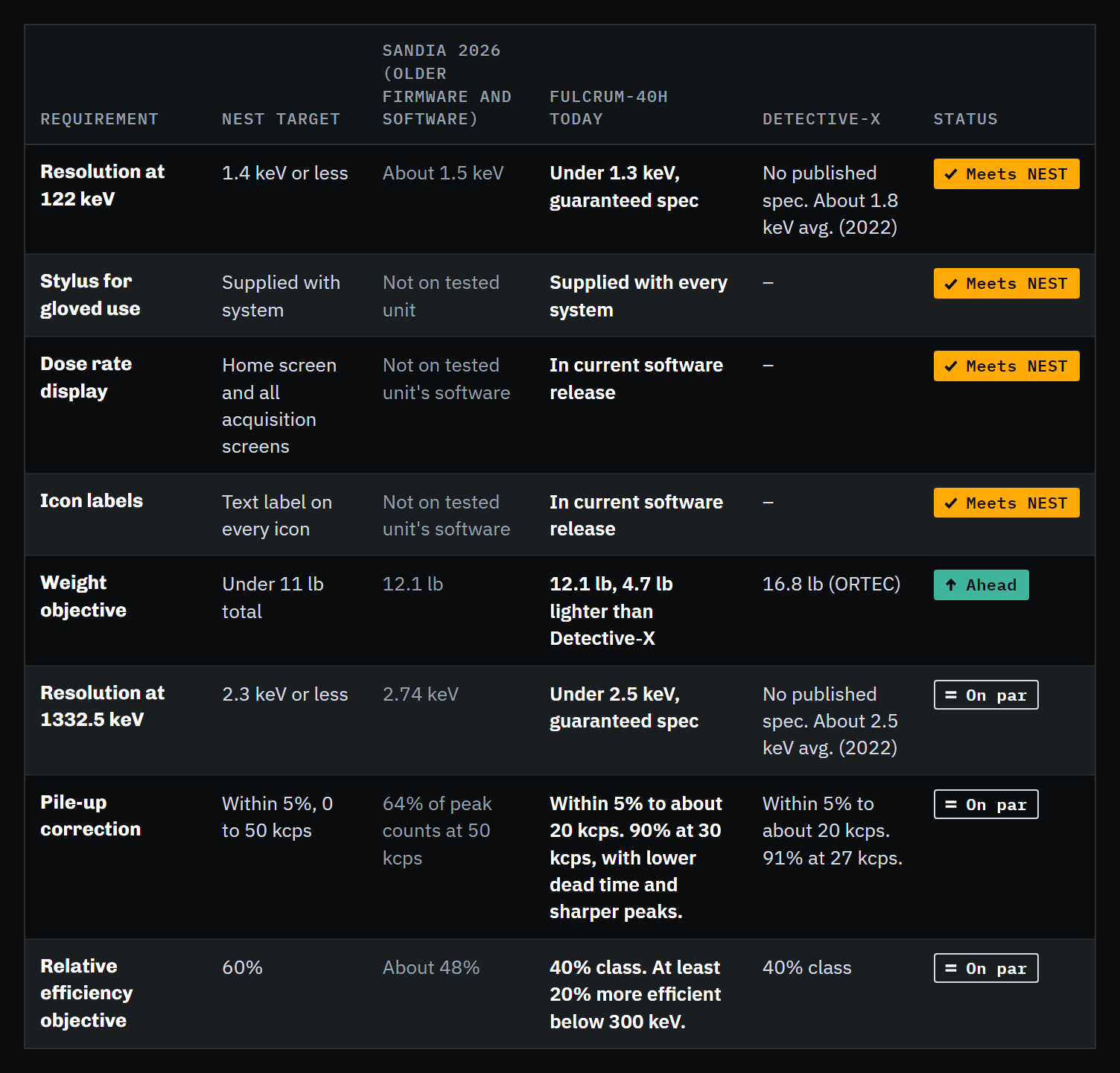
Figure 1 lists every NEST requirement the 2026 checklist did not record as met on the tested unit, alongside the Fulcrum-40h today and the Detective-X. Requirements met across the board are omitted.
3Initial testing scope
The original 2022 Sandia study measured efficiency and resolution on six new Fulcrum-40h units and six fielded Detective-X units (manufactured 2020 to 2022) [1]. Pile-up, neutron, and crosstalk tests used one unit of each. Key takeaways from the initial study were:
- The Fulcrum-40h was at least 20% more efficient than the Detective-X below 300 keV, the energy range that carries key uranium and plutonium signatures. Its larger 85 mm crystal diameter accounts for the difference.
- For in-situ surface measurements, the Fulcrum-40h was significantly more efficient below 100 keV.
- Energy resolution was comparable between the two systems, with an advantage to the Fulcrum-40h at low energies.
- Neither system showed gamma-to-neutron crosstalk.
- The Fulcrum-40h pile-up correction and resolution degraded above about 11.5 kcps. This was the main gap, and the focus of the firmware work described below.
Since the initial study, PHDS has implemented several software and firmware updates that dramatically improve the performance of the Fulcrum-40h and directly address the limitations from the 2022 study. However, these software and firmware updates were not used in the 2026 testing.
4Developments and improvements since 2022
In accordance with NEST requirements published in 2023, PHDS has implemented a variety of improvements to both the software and hardware of the Fulcrum-40h system. An overview of those improvements is provided below.
Power
- Internal batteries now charge from line power, and batteries are hot-swappable.
- System can be powered from 12 V DC adapters and external 2590 batteries.
Field operation
- Added a rotating user interface for tripod-mounted in-situ work.
- A stylus is supplied with the instrument for gloved operation.
- Fulcrum-40h units with the extended range option have a user-selectable 3 or 12 MeV range.
Software
- Added automatic gain stabilization and energy auto-calibration on common check sources.
- Neutron presence alarm and dose-rate or count-rate over-range warnings.
- Added error codes for troubleshooting.
- Files can now be saved to removable media.
- GPS tagging is available in the .N42 file.
Signal processing
- FPGA firmware update for count-rate-independent resolution and improved pile-up correction.
- Does not require new electronics and can be installed locally by the end user.
The minor user-interface items the 2026 checklist marked as not met were already implemented in the current software release:
- Dose rate is displayed on the home screen and on every acquisition screen.
- Graphic icons now carry text labels.
52026 testing results
5.1Energy resolution
Energy resolution measures how well the detector separates gamma-ray lines of nearby energies. NEST requirements set two targets: 1.4 keV or less at 122 keV, and 2.3 keV or less at 1332.5 keV [2].
Production units of the Fulcrum-40h now ship with guaranteed FWHM specifications: under 2.5 keV at 1332.5 keV and under 1.3 keV at 122 keV. For comparison, ORTEC does not publish an energy resolution specification for the Detective-X [4]. In Sandia's 2022 test, the six Detective-X units averaged about 2.5 keV at 1332.5 keV.
In its 2026 test, Sandia measured FF103 at about 1.5 keV at 122 keV and 2.74 keV at 1332.5 keV. Sandia had measured the same unit in 2022, and its 2026 report shows both sets of results side by side (Figure 2).
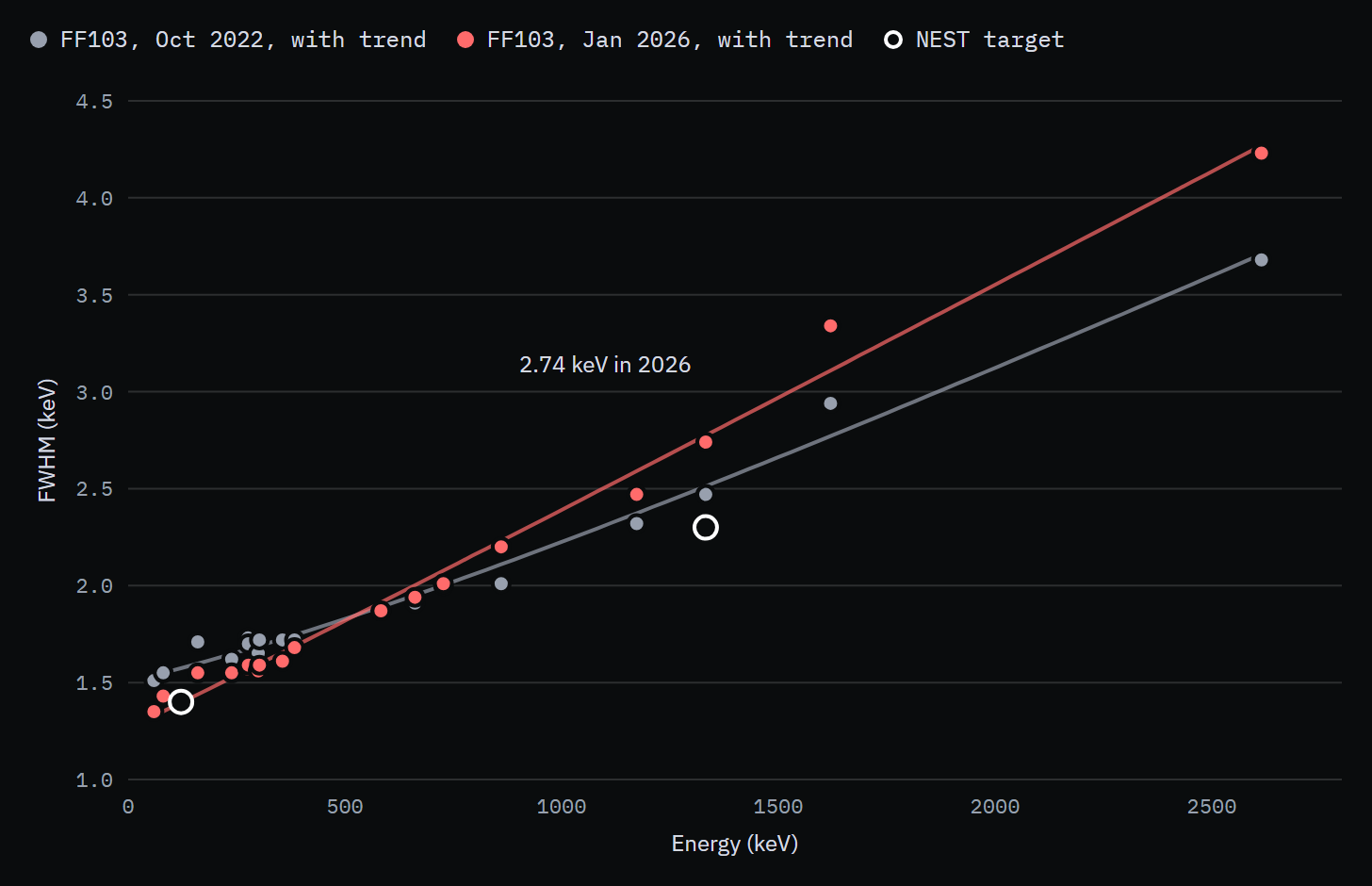
Comparing the two tells a clear story. Below 700 keV, the unit performed the same as or better than it did in 2022. Above 700 keV, it got worse. At 1332.5 keV, resolution went from 2.47 keV in 2022 to 2.74 keV in 2026.
That pattern is unusual. In a healthy HPGe detector, peak width grows slowly and predictably with energy. FF103's peak width in 2026 grew faster between 1173 and 1332 keV than a healthy detector physically allows. Its 2022 results stayed within that limit. The change therefore reflects something specific to this unit since 2022, not the Fulcrum-40h design.
5.2Efficiency and detector storage
Efficiency measures how sensitive a detector is to gamma rays. Sandia measured the relative efficiency of FF103 at about 48%, which meets the NEST threshold of 40%.
At high energies, the unit's efficiency was unchanged from 2022. At 1332.5 keV, the 2026 result was within 2% of the 2022 result. At low energies, it dropped: by 26% at 59.5 keV and by 13% at 160.6 keV.
Even after this efficiency loss, FF103 was still about 30% more efficient at 59.5 keV than the 2022 Detective-X average.
Sandia attributes this low-energy loss to growth of the detector's dead layer. The dead layer is a thin inactive surface on the outside of the crystal. It thickens slowly whenever the crystal is warm, and much faster when it is hot. A thicker dead layer blocks low-energy gamma rays before they can be detected, but high-energy gamma rays pass through it, which explains the observed low-energy efficiency degradation.
Every p-type coaxial HPGe detector has this dead layer, including the Detective-X. Sandia saw the same kind of low-energy variation in the fielded Detective-X units it tested in 2022.
5.3Neutron detection and crosstalk
The Fulcrum-40h met the NEST neutron detection requirement. For the reference Cf-252 source at 50 cm, Sandia estimated a 300-second signal of 2.96 sigma above background, above the 2.33 sigma required for 99% confidence.
Gamma radiation did not affect the neutron detector at any count rate tested, up to 50 kcps, consistent with the 2022 results.
5.4Pulse pile-up and high-rate performance
In a strong radiation field, gamma rays arrive so quickly that their signals can overlap. This is called pile-up. The detector has to correct for it, or its count of each gamma-ray line comes out too low.
NEST's threshold requires that this correction stay accurate within 5% from low count rates up to 50,000 counts per second (50 kcps) [2]. Peak sharpness may degrade by no more than 10% over the same range.
In 2022, the Fulcrum-40h's correction stayed within 10% only up to about 11.5 kcps, and its peaks broadened above that rate. The Detective-X stayed within 10% up to about 36 kcps. Neither system stayed within 5% across the full range.
5.5Firmware updates
A 2026 PHDS investigation identified and implemented a change to the Fulcrum FPGA firmware that dramatically improves pile-up correction and energy resolution at high count rates. The investigation found that very small pulses, too small to trigger a measurement, were shifting the reference level each pulse is measured against, which moved counts out of the peak and into a shoulder just below it.
In a Cs-137 test at 30 kcps, the fix cut the misplaced counts below the peak by about 30% and returned them to the peak. It does not discard any events or add dead time.
This updated firmware does not require new electronics and can be installed locally by the end user. Figure 3 compares its pile-up correction with the 2022 results for both systems.
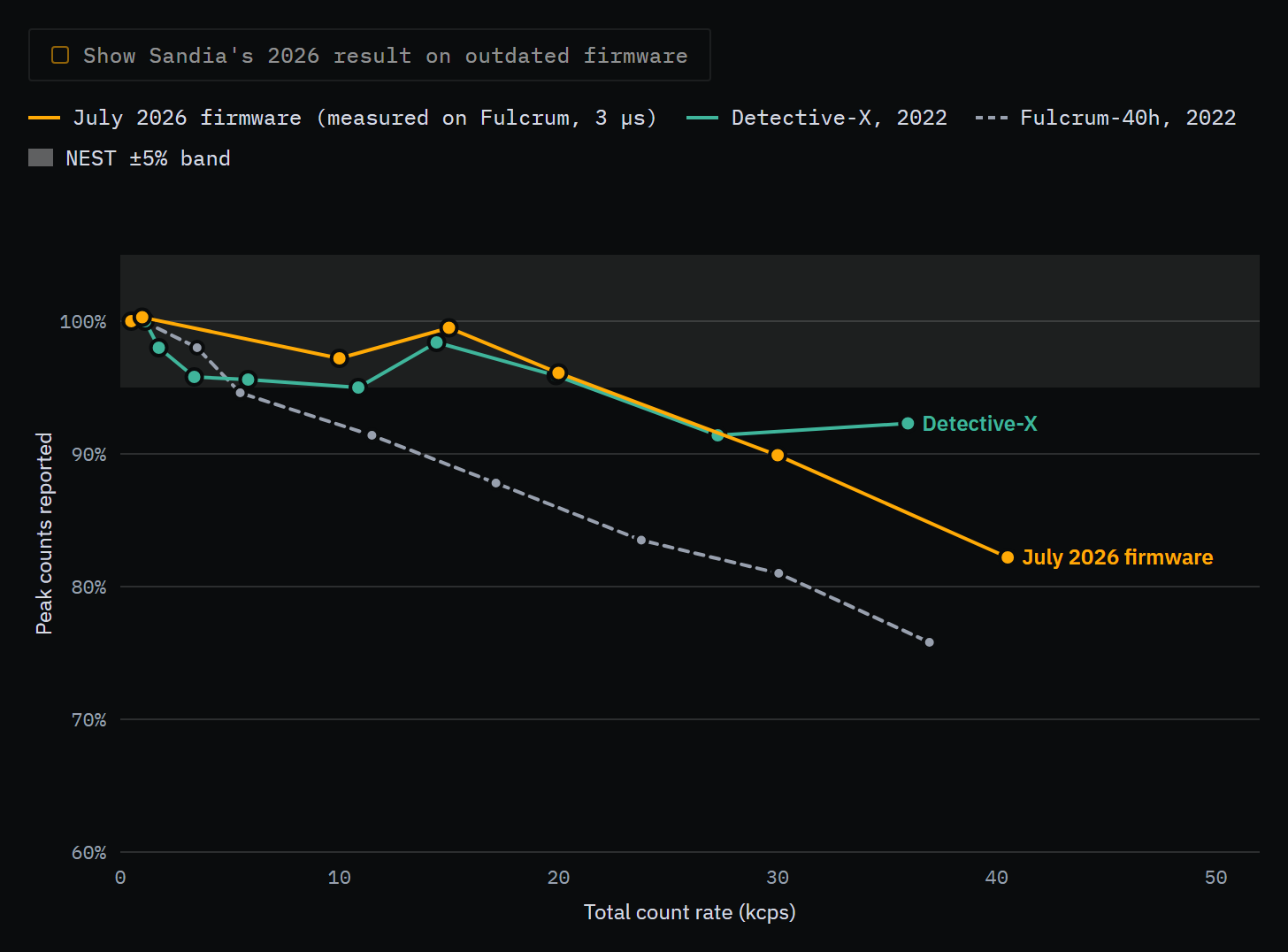
Figure 4 shows peak width over the same range of count rates: measured at 583 keV for both systems in 2022, and expected at 662 keV for the Fulcrum-40h with the current firmware.
5.6Results
PHDS conducted tests with the new firmware to compare against the initial Sandia study, and observed the following improvements. These tests used a base Fulcrum, which runs the same FPGA signal processing as the Fulcrum-40h, so count-rate performance carries over directly:
- Peak sharpness no longer depends on count rate. Resolution stays flat from 1 to 40 kcps, with under 10% degradation across that range. A Fulcrum-40h is expected at about 1.7 to 1.8 keV at 662 keV over the same range. The Detective-X measured about 2.1 keV at 583 keV in 2022.
- Updated pile-up correction is on par with the Detective-X. It stays within 5% up to about 20 kcps, the same as the Detective-X in 2022.
- Lower dead time at high count rates. Dead time is the share of time the detector electronics cannot detect new events during signal processing. At 30 kcps it is 41% (3 µs peaking time) or 58% (5 µs peaking time). The Detective-X measured 60% at 27 kcps in 2022.
- At 30 kcps, the Fulcrum-40h reports 90% of the expected peak counts. That compares with 81% for the 2022 Fulcrum-40h and 91% for the Detective-X at 27 kcps.
- At 36 kcps, the Fulcrum-40h reports about 86% of the expected peak counts. Interpolated from PHDS measurements at 30 and 40 kcps. That compares with 76% for the 2022 Fulcrum-40h at 37 kcps and 92% for the Detective-X at 36 kcps.
Since the 2022 study, the Fulcrum-40h has closed the gap to the Detective-X. At 30 kcps, the difference in the pile-up correction has narrowed from 10 percentage points to 1. At 36 kcps it has narrowed from 16 points to about 6, and PHDS continues to work on that range.
6Areas for future improvement
On four NEST targets, neither the Fulcrum-40h nor the Detective-X meets the requirement, based on Sandia's data and ORTEC's published specifications. On each, the Fulcrum-40h is comparable to or better than the Detective-X. PHDS will continue to improve the system to better support the NEST mission.
- Energy resolution threshold (2.3 keV or less at 1332.5 keV). The Fulcrum-40h specification is under 2.5 keV. The Detective-X has no published specification and averaged about 2.5 keV in 2022.
- Weight objective (under 11 lb total). The Fulcrum-40h weighs 12.1 lb with two batteries installed. ORTEC lists the Detective-X at 16.8 lb (gamma and neutron) [4]. The Fulcrum-40h is 4.7 lb lighter and 1.1 lb from the objective.
- Relative efficiency objective (60%). Both systems are 40% class. At 1332.5 keV their measured efficiencies agree within 3%. Below 300 keV, the Fulcrum-40h averaged at least 20% more sensitive in 2022 because of its larger 85 mm crystal diameter.
- Pile-up correction threshold (within 5% to 50 kcps). The Fulcrum-40h matches the Detective-X correction to 30 kcps, with lower dead time and narrower expected peaks at every rate tested. Since 2022, it has narrowed the gap above 30 kcps as well.
7Keeping your system up to date
PHDS offers a variety of user-friendly methods for updating software and firmware, including remote updates that can be downloaded directly to the system. We recommend all users keep their units up to date, when possible. If you need assistance updating your system, contact our technical support team.
References
- M. W. Enghauser, Assessment of PHDS Fulcrum40h and Ortec Detective-X High Purity Germanium (HPGe) Detector System Performance, SAND2022-10393, Sandia National Laboratories, 2022. December 2022.
- K. G. Hart and M. W. Enghauser, Nuclear Emergency Support Team High Purity Germanium Detector System Requirements Document, SAND2025-03163, Sandia National Laboratories, 2025. Revision 1.
- M. W. Enghauser and A. B. Christensen, Reassessment of PHDS Fulcrum40h High Purity Germanium (HPGe) Detector System Performance, SAND2026-20186, Sandia National Laboratories, 2026. April 2026.
- ORTEC, Detective-X product brochure.