Radioisotope production runs on tight release criteria and short half-lives. Every batch needs a confirmed identity, a documented radionuclidic purity, and a defensible activity measurement, often within hours of synthesis. PHDS’ compact high-purity germanium (HPGe) systems offer laboratory-grade gamma spectroscopy next to the hot cell or the QC bench, with the energy resolution to quantify impurities and the software controls a regulated lab requires.
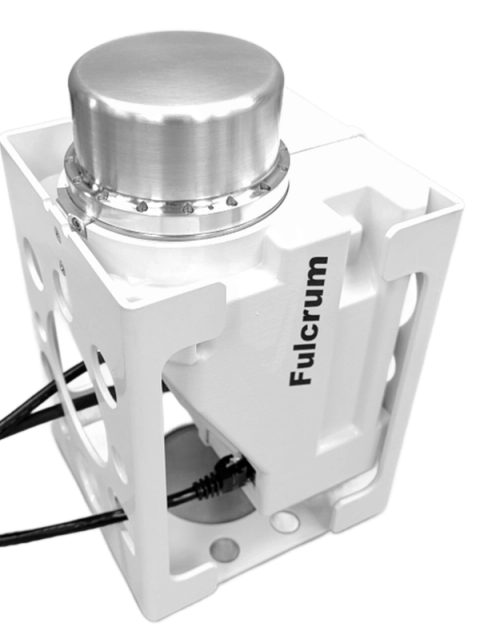
The detector is the Fulcrum-L, a laboratory HPGe spectrometer that runs on a long-lived Stirling-cycle cooler, which requires no liquid nitrogen. It resolves gamma lines to better than 1.0 keV FWHM at 122 keV and covers gamma rays from 40 keV to 3 MeV. That resolution is what lets you separate a product peak from a trace impurity sitting a few keV away.
Radionuclidic purity measurements
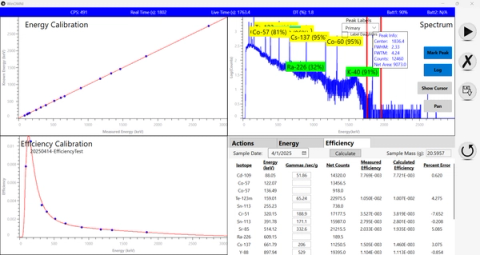
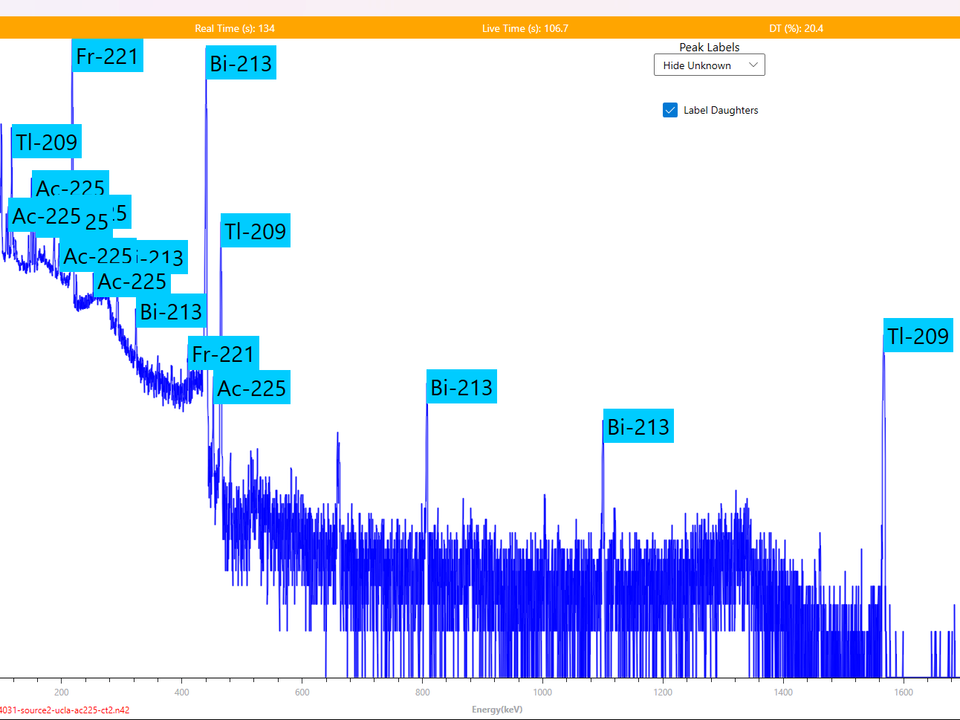
HPGe is the reference method for radionuclidic identity and purity testing. WinOMNI matches detected peaks against a comprehensive nuclide library and labels lines that do not belong, including decay-chain daughters and generator breakthrough. Resolution matters most where an impurity sits close to the product line. Pb-212 therapy product is the textbook case: the parent Ra-224 impurity has to be quantified at the fraction-of-a-percent level, and only a high-resolution detector can pull it cleanly off the Pb-212 lines.
Quantitative activity assay
The ISOTAC NDA module converts identified peaks into absolute activity and concentration, with an itemized uncertainty budget for each line and a minimum detectable activity (MDA) for every library nuclide that was not seen. Efficiency is modeled from the detector and source geometry, so routine assays do not depend on a shelf of decaying calibration standards.
Built for a GMP environment
WinOMNI-GMP is 21 CFR Part 11 compliant. It separates Administrator, Operator, and Reviewer roles, requires electronic signatures through the workflow, and writes a tamper-evident audit log of every action. Measurement profiles lock the acquisition and analysis settings so a release measurement runs the same way every time. PHDS supports IQ/OQ/PQ validation, and exports .n42, .pdf, .csv, .chn, .spe, and .spc for your batch records.
A turnkey low-background station
The Shield Cart houses the Fulcrum-L in a two-inch lead enclosure with a copper liner to suppress lead x-rays, giving a low-background counting geometry on heavy-duty casters. It rolls between the production suite and the QC lab and runs on wall power or battery. Optional fixed-distance source holders give a repeatable counting position for routine release work. Together the three pieces form a self-contained low-background counting lab that does not need a fixed shielded room.
Isotopes and production workflows
The same station supports the isotopes driving the radiotherapeutics field today:
• Ac-225 and its decay-chain signatures (Fr-221 at 218 keV, Bi-213 at 440 keV) for targeted alpha therapy
• Pb-212 by its 238.6 keV line for alpha-emitter and 212Pb generator workflows
• Lu-177 by its 112.9 and 208.4 keV lines, with Lu-177m impurity quantification
• Y-90 and other pure beta emitters, screened for gamma-emitting radionuclidic impurities
• PET isotopes including Ga-68 and F-18, with Ge-68 breakthrough testing on generator-produced Ga-68
One station, turnkey solution
The Fulcrum-L, WinOMNI-GMP, and Shield Cart give a production or QC lab a complete HPGe identity, purity, and activity capability in a footprint that fits beside the work, with no liquid nitrogen and no fixed counting room. For the upstream work of developing and monitoring those separations, see Radiochemistry application page, where the NP Imager adds real-time imaging of activity moving through a column. Talk to a PHDS applications engineer about your isotopes and release criteria, or request a demo.