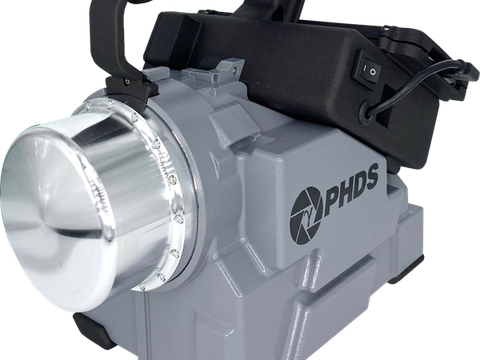
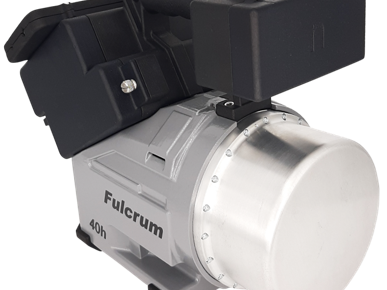
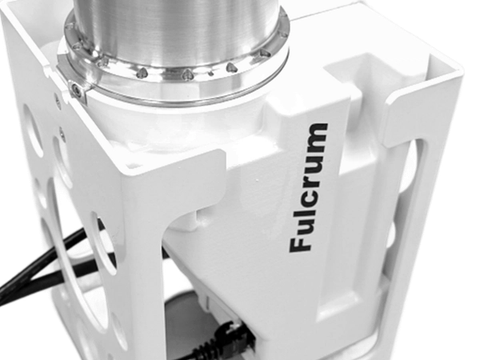
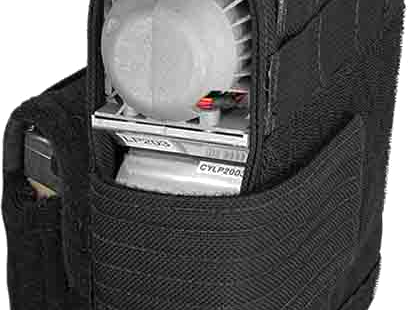
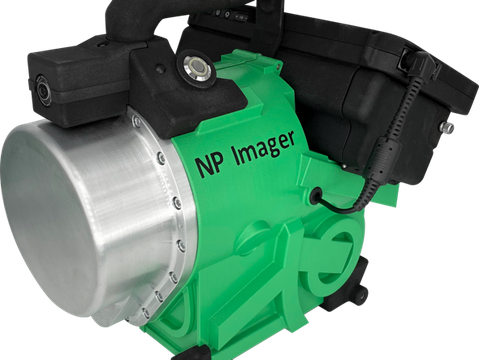
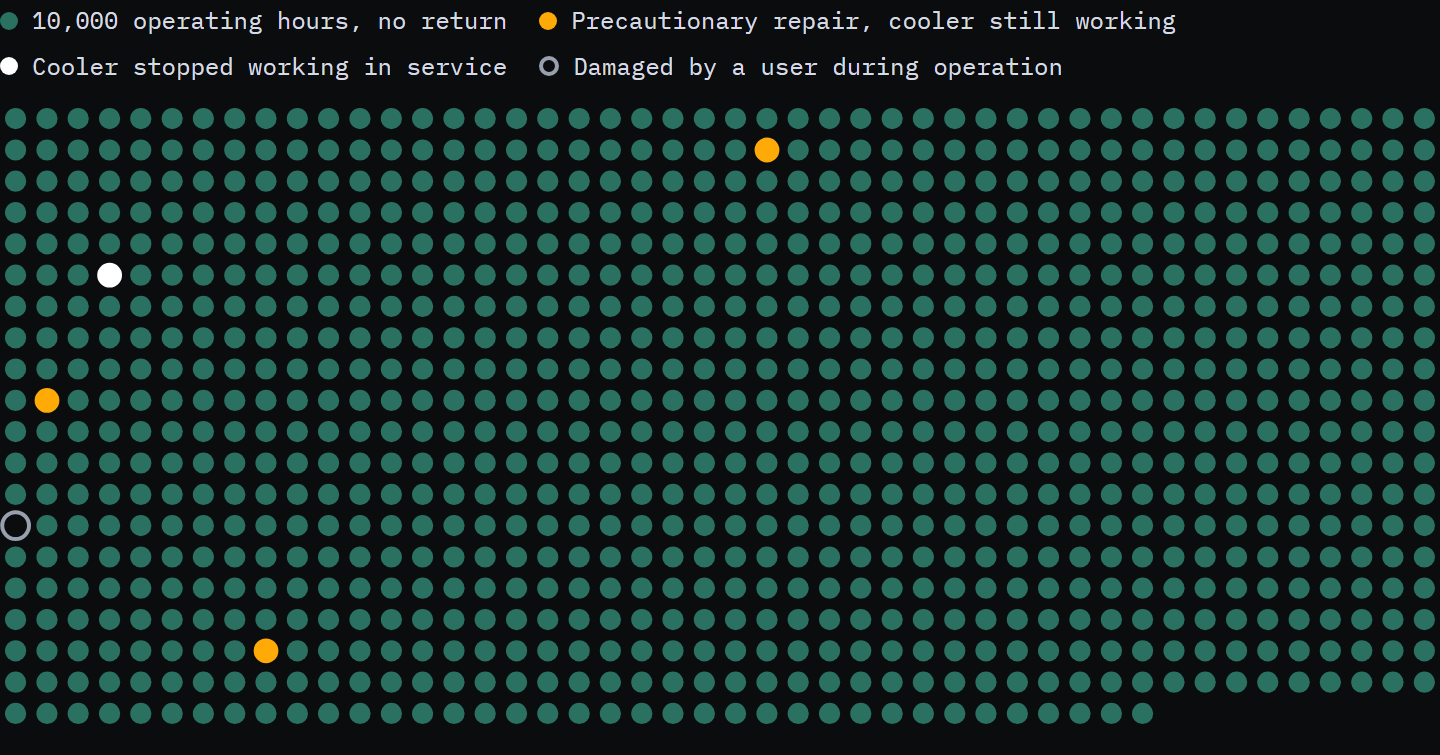
PHDS counted every cooler ever returned for repair across its fielded GeGI, NP Imager, Fulcrum-family and LoPro systems. The data supports a cooler Mean Time to Failure (MTTF) of 1.8 million operating hours.
1.8 million hours
Cooler MTTF from field data
Point estimate: 9.11 million operating hours, 5 returns
0.4%
Chance a cooler needs repair in any given year of service
At the point estimate, about 7,000 operating hours per year
0
Failures of any kind in coolers past year 3
About 45% of all fleet operating hours
Cooler reliability is one of the first questions users ask about a mechanically cooled HPGe detector, and they have reason to. Published cooler figures are hard to compare: some count only certain failures, some give no number at all, and few show how the number was calculated. This note answers the question for PHDS systems using field data from 264 production coolers of the current cooler platform, across GeGI, NP Imager, Fulcrum-family and LoPro systems, with calculations readers can check.
The result: a cooler MTTF of 1.8 million operating hours. This is the point estimate, total operating hours divided by the number of returns, and it is the figure used throughout this note. The Method section at the end shows the full calculation, including the 90% lower confidence bound for every figure. To be as conservative as possible, PHDS counts every cooler ever returned for repair as a failure, even though three of those coolers were still reaching operating temperature and one was damaged by a user during operation. We'll cover four common questions in the sections below.
How likely is my cooler to need a repair?
In a fleet of 100 systems, expect about one cooler repair every 2.6 years.
That is a 0.4% chance that any one cooler needs a repair in a given year of service. MTTF is the average number of operating hours a cooler runs before it needs repair. Figure 1 shows what the PHDS fleet MTTF means over ten years of service.
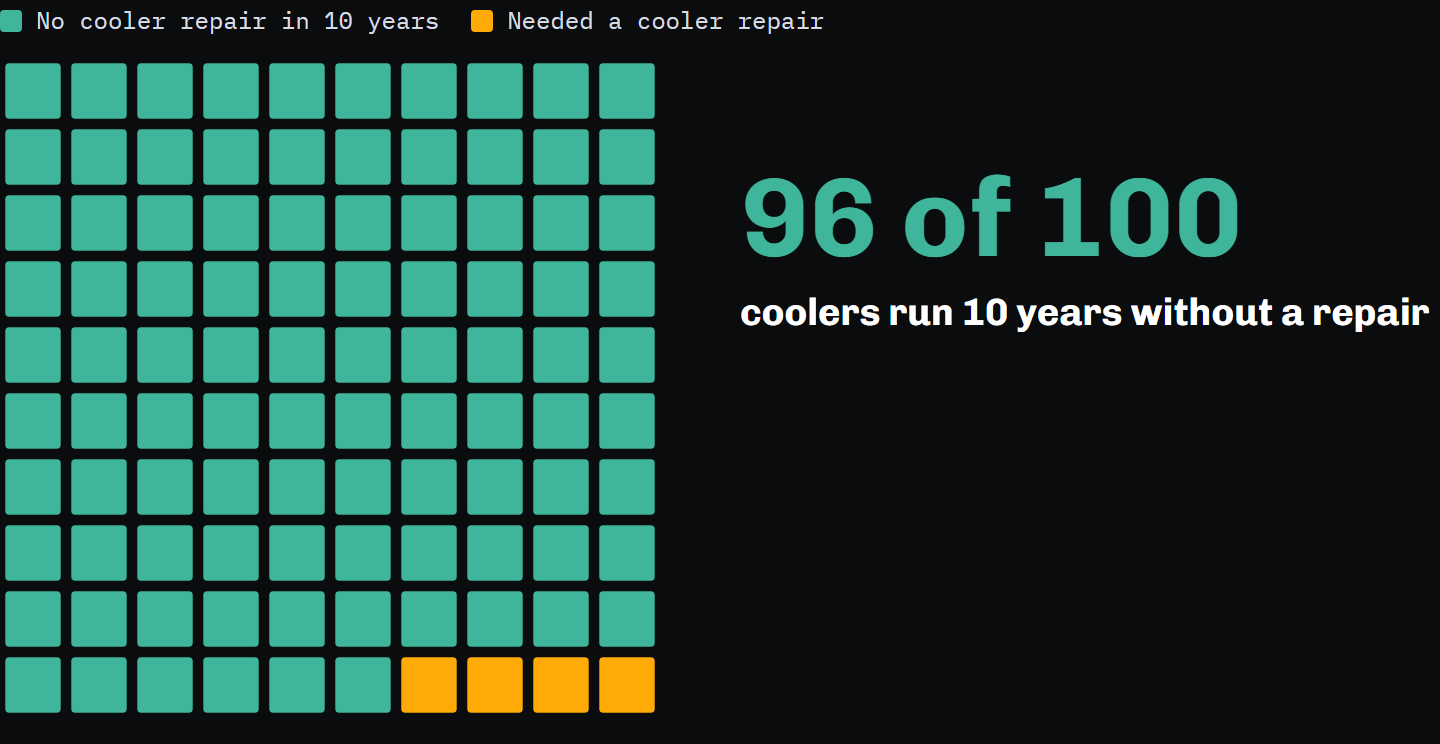
At smaller scale the picture is the same. A fleet of 10 systems would expect fewer than one cooler repair across the entire fleet in 10 years of service, about 0.4 repairs in total.
How does it compare?
Among portable HPGe systems, PHDS is the only manufacturer we found that publishes a cooler MTTF.
Published cooler figures come from very different kinds of systems, and weight is the quickest way to tell them apart (Figure 2). A portable instrument is carried by one person, runs on batteries, gets shipped between deployments, and works in field temperatures. Mirion describes its 36.5 lb battery-powered Aegis as transportable. The two most often quoted figures, ORTEC's ICS and Mirion's Cryo-Pulse 5 Plus, belong to AC-powered cooling systems for laboratory HPGe detectors, with no battery operation. PHDS also offers a laboratory instrument, the Fulcrum-L. Laboratory figures are useful context, not an apples-to-apples comparison.
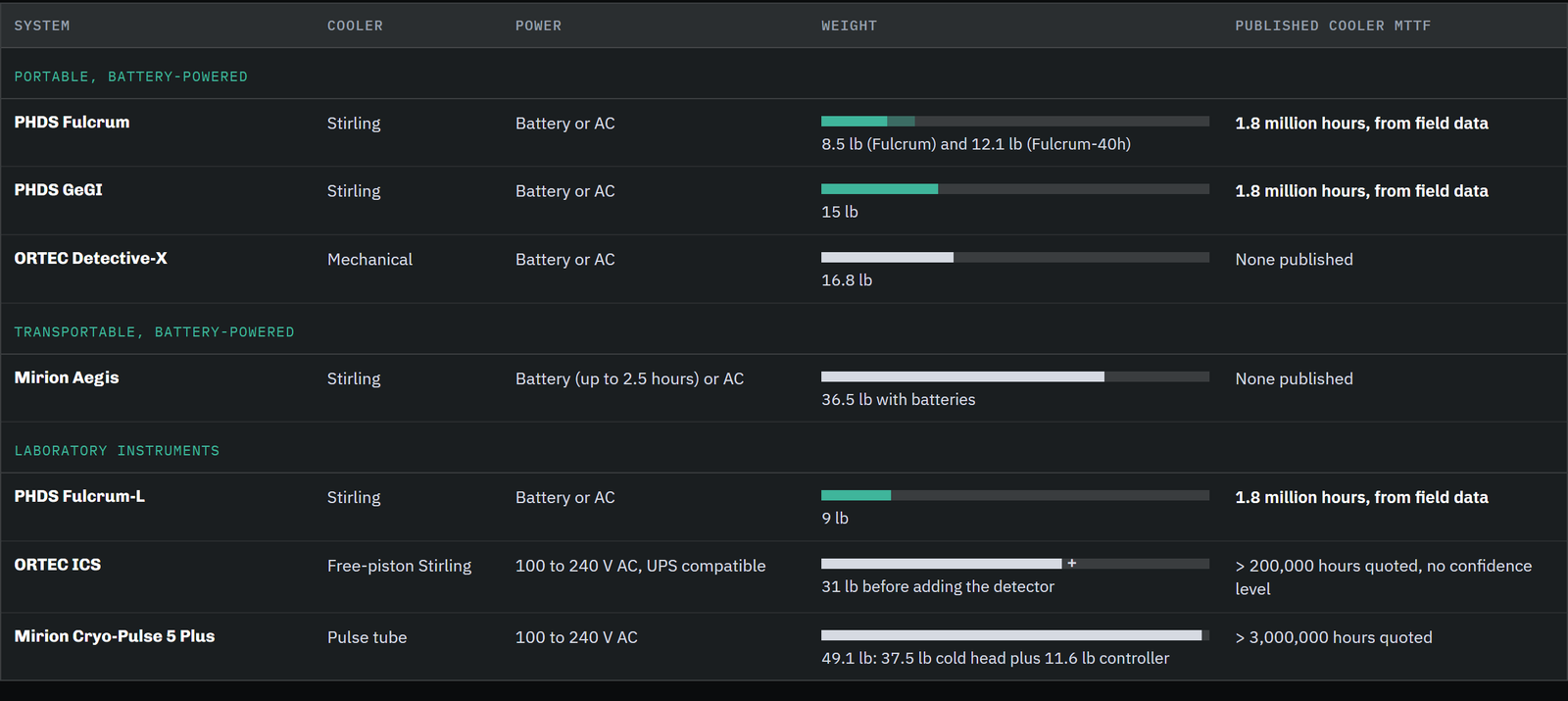
- Portable and transportable systems. Neither ORTEC's Detective-X brochure [9] nor Mirion's Aegis data sheet [6] gives a numerical cooler MTTF. The Aegis uses a Stirling cooler, the same broad cooler family as the ICS, in a 36.5 lb transportable package, three times the weight of a Fulcrum-40h.
- ORTEC ICS. ORTEC quotes a cooler MTTF of more than 200,000 hours and a 2-year cooler warranty [2]. The cooler maker states that the figure comes from an independent third-party analysis of customer returns and in-house testing, and gives a recommended design life of 5 years [3]. No confidence level is stated. The PHDS figure is about nine times higher.
- Mirion Cryo-Pulse 5 Plus. Mirion quotes more than 3,000,000 hours [4, 7]. The supporting paper reports 2 failures in 32.8 million operating hours across about 1,100 coolers, and a laboratory failure-mode analysis giving an expected MTTF of about 119,000 hours [5]. Pulse-tube coolers have no moving parts at the cold end, which favors long life. Mirion does not publish a comparable figure for its portable Stirling-cooled Aegis.
- RICOR tactical rotary and linear Stirling coolers. Developed for infrared imaging and sometimes used in compact HPGe instruments. Published MTTF values are 9,000 to 35,000 hours at 23 °C and 100% operation, with a wear-out Weibull life distribution [8]. The PHDS figure is about 50 to 200 times higher.
Do the coolers wear out?
Not so far. No PHDS cooler has been returned for any reason after its third year, and coolers past year 3 account for about 45% of all fleet operating hours.
Cooler failures come in two broad types. Early-life failures appear in the first years of service. Wear-out failures become more frequent as coolers age, and are what most users worry about with mechanical cryocoolers. Figure 3 shows where the fleet's operating hours and its five events fall by cooler age.
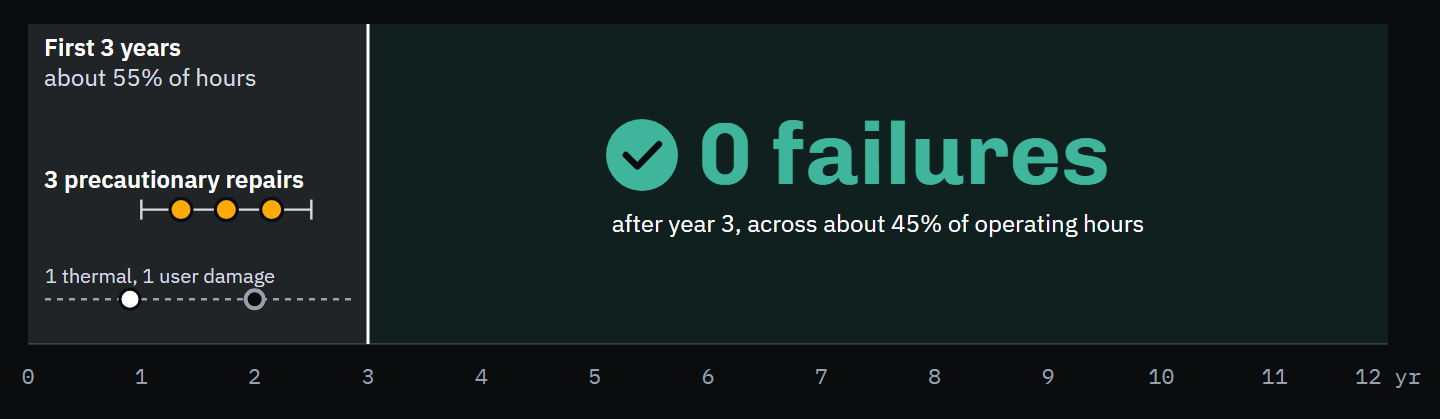
Most of the early events are not breakdowns. Three were precautionary repairs on coolers that still reached operating temperature but had become audibly noisy. One was a system damaged by a user during operation, not a cooler fault. Only one, the thermal event, was a cooler that stopped working in service. Even counting all five against the first three years of service, the chance of a return in any one of those years is about 0.7%.
The hours past year 3 are a large sample on their own: about 4.1 million operating hours with zero returns. The pattern points to early-life events rather than wear-out, so the constant-failure-rate model used in this note is conservative for mature coolers. We have not yet seen the rising late-life failure rate expected from bearing, seal, or regenerator wear.
Load matters too. All four GeGI-family events, including the three precautionary repairs, were on imaging systems (GeGI and NP Imager), which operate the cooler at a substantially higher steady-state heat load. The spectroscopy family (Fulcrum, Fulcrum-L, Fulcrum-40h and LoPro) has nearly identical total exposure, about half the fleet's operating hours, and its only recorded event is a unit damaged by a user during operation. Even counting that unit, the spectroscopy family has one event in about 4.6 million operating hours. Five events are too few for a firm statistical conclusion, but the observation is consistent with general cryocooler experience: reliability improves as the cooler runs further below its maximum heat-lift capacity.
The bottom line
Counting every return as a failure, the PHDS cooler fleet supports an MTTF of 1.8 million operating hours. That is six times the 300,000-hour PHDS specification.
- The chance that a cooler needs repair in any given year of service is about 0.4%.
- No cooler has been returned after its third year, in a fleet with coolers up to 12 years old.
- The Fulcrum family, including LoPro, has no cooler-internal failure on record. Its only return was a unit damaged by a user during operation, one event in about 4.6 million operating hours.
- Among portable HPGe systems, PHDS is the only manufacturer we found that publishes a cooler MTTF, with field data to corroborate the claim.
For Fulcrum users, the practical message is simple: keep the system powered and cold between deployments, and expect the cooler to keep running.
Don't take our word for it
The data speaks for itself. Every choice in the calculation is intentionally conservative, and every step is shown below so you can check it.
Any MTTF figure depends on three choices: what counts as a failure, what counts as an hour, and how the uncertainty from a small number of failures is reported.
- PHDS treated every return as a failure. This is a deliberately conservative choice, not a description of what happened. Three of the five returned coolers were still reaching operating temperature, and one was damaged by a user during operation. Counting them all lowers the result.
- Operating hours, not calendar hours. About 1,300 cooler-years of calendar exposure, counted from each system's checkout date, converts to 9.11 million operating hours using the measured duty cycle of about 0.80 from cooler run-time counters.
- A point estimate in the main text, a confidence bound here. The main text quotes the point estimate, total operating hours divided by the number of returns. Five events leave real statistical uncertainty, so this section also gives the 90% lower confidence bound for every figure in the note.
The five returns were three precautionary repairs, where the coolers still reached operating temperature but developed audible noise; one thermal event, where the cooler most likely overheated in service; and one system damaged by a user during operation, which broke its cold link. Failures induced during R&D stress testing of non-production units are excluded. A narrower failure definition raises the result (Table 1).
| Failure definition | Events counted | MTTF point estimate | MTTF 90% lower bound |
|---|---|---|---|
| hours | hours | ||
| Every repair return (this note) | 5 | 1.8 million | 980,000 |
| Excluding user damage | 4 | 2.3 million | 1.1 million |
| Loss of cooling only | 1 | 9.1 million | 2.3 million |
With total operating time and failures, the point estimate under a constant failure rate is:
For a time-terminated test, the one-sided 90% lower confidence bound is [1]:
Run in reverse, the same calculation gives the confidence behind any stated MTTF. The fleet data supports the 300,000-hour PHDS specification at better than 99.99% confidence. Table 2 gives every figure in this note at both the point estimate and the 90% lower bound.
| Figure | Point estimate (this note) | 90% lower bound |
|---|---|---|
| Fleet cooler MTTF | 1.8 million hours | 980,000 hours |
| Chance of a cooler repair in a given year | 0.4% | 0.7% |
| Fleet of 100: one cooler repair every | 2.6 years | 1.4 years |
| Fleet of 100: repairs in 10 years (Figure 1) | 3.8 | 6.9 |
| Fleet of 10: repairs in 10 years | 0.4 | 0.7 |
| Spectroscopy family MTTF (1 event) | 4.6 million hours | 1.2 million hours |
| Coolers past year 3 (0 events) | Not defined, no events | 1.8 million hours |
| Multiple of the 300,000 hours PHDS spec | 6 times | 3 times |
| Multiple of ORTEC ICS quoted 200,000 hours | 9 times | nearly 5 times |
| Multiple of RICOR 9,000 to 35,000 hours | about 50 to 200 times | 28 to 109 times |
| Multiple of NEST MTBF threshold / objective | 91 / 36 times | 49 / 20 times |
For NEST program managers
The NEST HPGe Detector System Requirements (Rev. 1, SAND2025-03163) set an MTBF threshold of 20,000 hours and an objective of 50,000 hours for the full system, hardware and software [10]. Sandia's 2026 reassessment of the Fulcrum-40h (SAND2026-20186) recorded MTBF as not assessed [12]. This study covers the cooler subsystem only. Its MTTF is about 90 times the threshold and 36 times the objective, and still 49 and 20 times at the 90% lower bound.
References
- U.S. Department of Defense, MIL-HDBK-781A: Handbook for Reliability Test Methods, Plans, and Environments for Engineering, Development, Qualification, and Production, 1996.
- ORTEC, ICS Integrated Cryocooling System brochure.
- Sunpower, CryoTel cryocooler FAQ.
- Mirion Technologies, Cryo-Pulse 5 Plus electrically refrigerated cryostat.
- D. Willems, R. Arts and B. Douwen, State-of-the-art cryocooler solutions for HPGe detectors: Cryo-Pulse 5 Plus, Thales Cryogenics and Canberra, 2015. July 2015.
- Mirion Technologies, Aegis Portable HPGe Spectrometer data sheet, SPC-194-EN-E, 2024. May 2024.
- Mirion Technologies, Cryo-Pulse 5 Plus spec sheet, SPC-177.
- RICOR, Overview of RICOR's reliability: theoretical and actual.
- ORTEC, Detective-X product brochure.
- K. G. Hart and M. W. Enghauser, NEST HPGe Detector System Requirements Document, SAND2025-03163, Sandia National Laboratories, 2025. Rev. 1.
- PHDS Co., Fulcrum-40h response to the 2022 and 2026 Sandia evaluations against the NEST HPGe requirements, Technical note, 2026. September 2026.
- M. W. Enghauser and A. B. Christensen, Reassessment of PHDS Fulcrum40h HPGe Detector System Performance, SAND2026-20186, Sandia National Laboratories, 2026. April 2026.